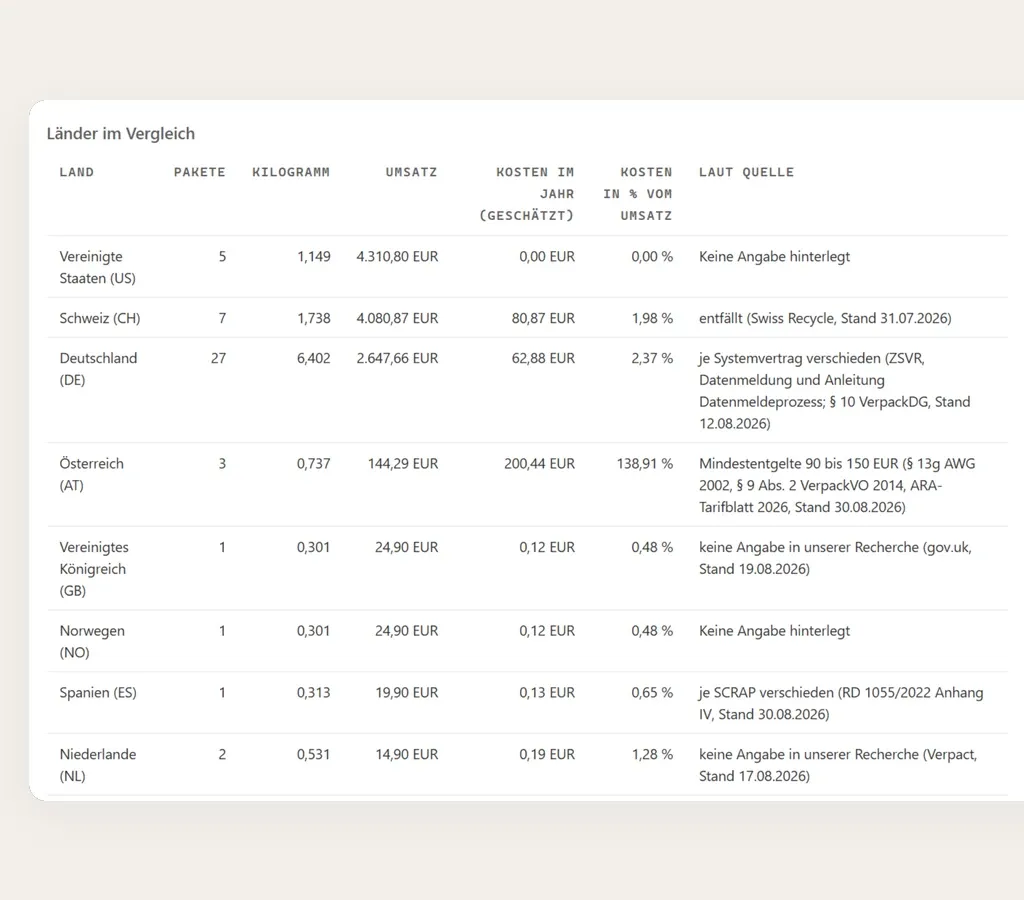
What each country costs you.
Parcels, kilograms and revenue per destination, next to your own yearly costs. From Starter. What follows is your call.
Before you stop shipping anywhere, get the figures: Kolli shows how much packaging you send to each destination country, from real shipments, with an audit trail. You ship as usual. The volumes build themselves.
Kolli is in the Shopify App Store and can be installed via the direct link. It does not appear in the store search yet.
The background: so far, registration and volume reporting have run separately in every destination country, under that country’s own rules. France, for instance, has issued an EPR number since 2022. The PPWR now provides for registration per member state itself (Article 44); registration still takes place in the national registers, in Germany in LUCID. What follows from that for your shop is a question for your advisers. Kolli supplies the figures.
The question isn’t how much you sold. It’s this: how many kilograms of cardboard, plastic and aluminium went to Austria last year? To France? To the Netherlands?
If you can’t answer that, you are deciding blind, and in case of doubt you stop shipping to a country that would have paid off.
More background on the blog: The German packaging register LUCID: an overview for Shopify merchants
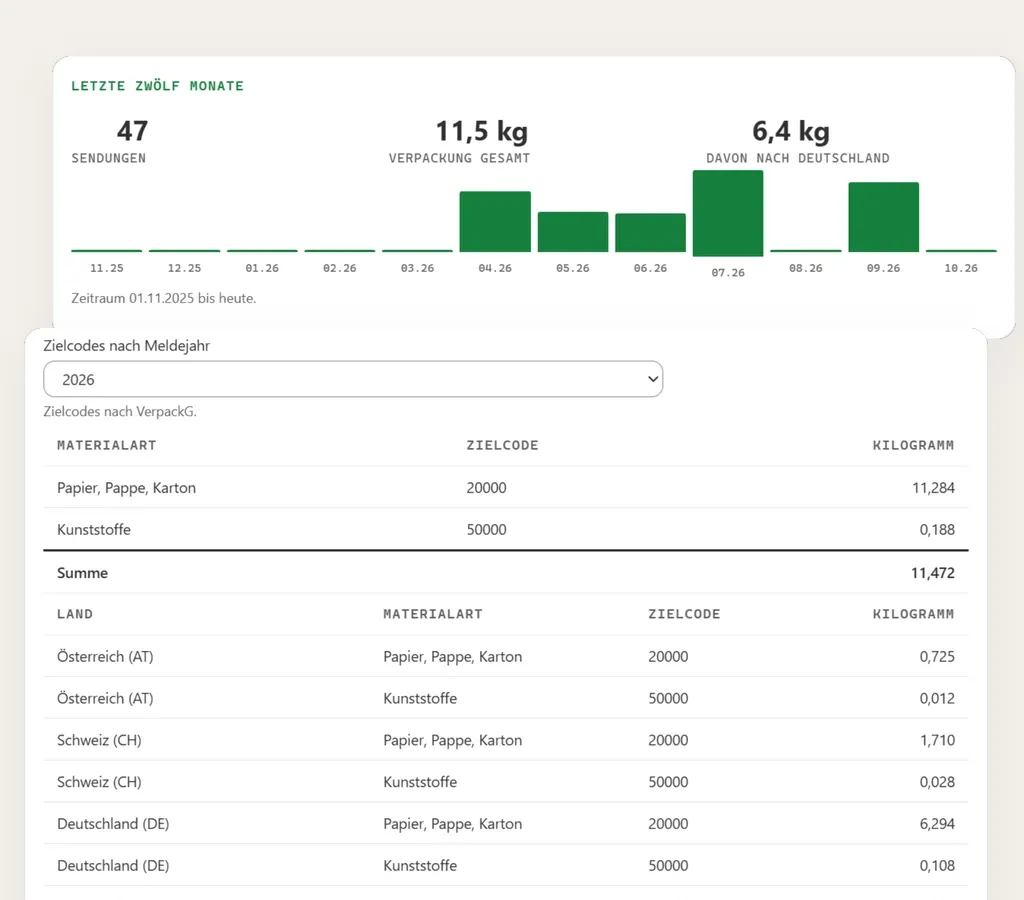
Parcels and kilograms per destination country, across twelve months.
Internally Kolli works with finer fractions and maps them onto the material types LUCID requires for the reporting year: those of the German VerpackG for volumes from 2026 (section 68(5) VerpackDG), and the VerpackDG code set from reporting year 2027.
From the total back down to the single shipment.
Kolli listens to your shop’s shipments and writes a row for each one: destination country, timestamp, order and shipment identifier. Kolli reads the current and the previous calendar year once you start the backfill in the app; after that it keeps running.
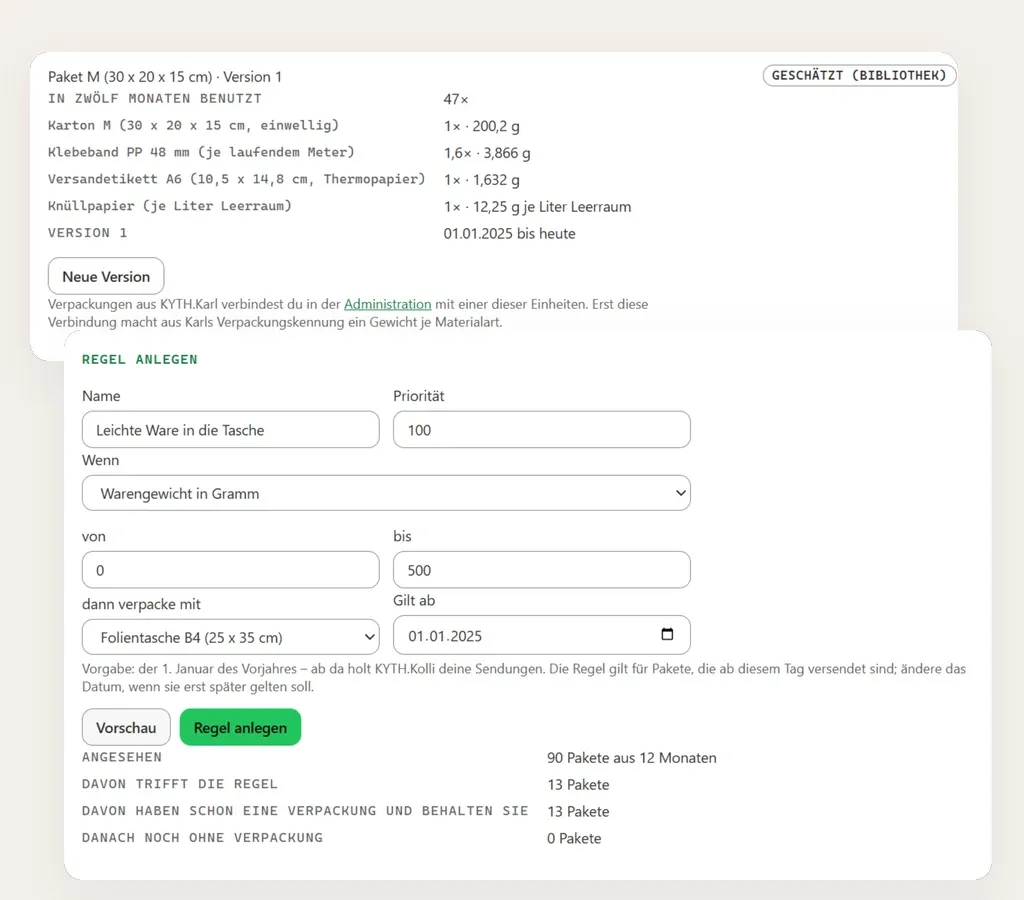
You enter weights in grams: box S weighs 210 g of cardboard, plus 4 g of tape and 30 g of cushioning. Packaging on the product goes in on top of the shipping packaging, on every plan. Parcels that have no packaging assigned yet get one in a single step. Kolli links every shipment to its packaging and converts counts into weights per material. With KYTH.Karl, Kolli knows from the shipping label which box was actually packed. Without Karl, your rules and a default packaging apply.
The app’s home page shows the “Jahresmeldung” (annual declaration) and the kilograms per country and material fraction, the deadlines for Germany and Austria sit in the app’s deadline calendar, and the exports are ready when you need them. The frequently asked questions in the app are searchable.
A good minute and a half through the app: quantities per country, packaging and rules, the way to the report and „Länder im Vergleich“ (countries compared). Spoken in German, with English subtitles.
In the video (104 seconds) the narration in German is by founder Stefan Grasse; English subtitles are on by default, and the interface shown is German. Narration in English: Hi, I'm Stefan from KYTH. In a moment I'll show you how KYTH.Kolli turns your Shopify shipments into the packaging quantities for your report. The app reads your shipments and works out how much packaging you sent to which country, in kilograms per material type, month by month. At the press of a button, also backdated for the current and the previous year. For that you set up your boxes, mailing bags and filling material once. Rules assign the right packaging to every parcel, by weight, country or product. And if you have not weighed yet, it uses a reference value until you weigh it yourself. Every parcel stays traceable: which packaging, how many grams per material, and why a test order does not count. The app takes you to the report step by step: check the figures, lock them and, for Germany, create the LUCID file and the report for your dual system. Uploading and reporting is up to you. And if you are wondering whether a country is still worth it, for example because of the cost of an authorised representative: „Länder im Vergleich“ (countries compared) shows you parcels, kilograms and revenue per country next to your own costs. What follows from that is your call. Start free of charge: with up to 100 parcels a month you get the country overview and the annual CSV for your home country. If you ship more, need the LUCID file or want „Länder im Vergleich“, take Starter or Pro. KYTH.Kolli, now on the Shopify App Store.
The figures in the video are sample data from a development store, the same as in the screenshots further down. The recording still shows the app in its earlier typeface. More precisely than said in the video: the annual CSV is available for the home country Germany or Austria, and the country overview comes without a parcel limit on every plan.
Parcels, kilograms and revenue per destination, next to your own yearly costs. From Starter. What follows is your call.
From your shipments, Kolli works out the kilograms per destination and material, month by month.
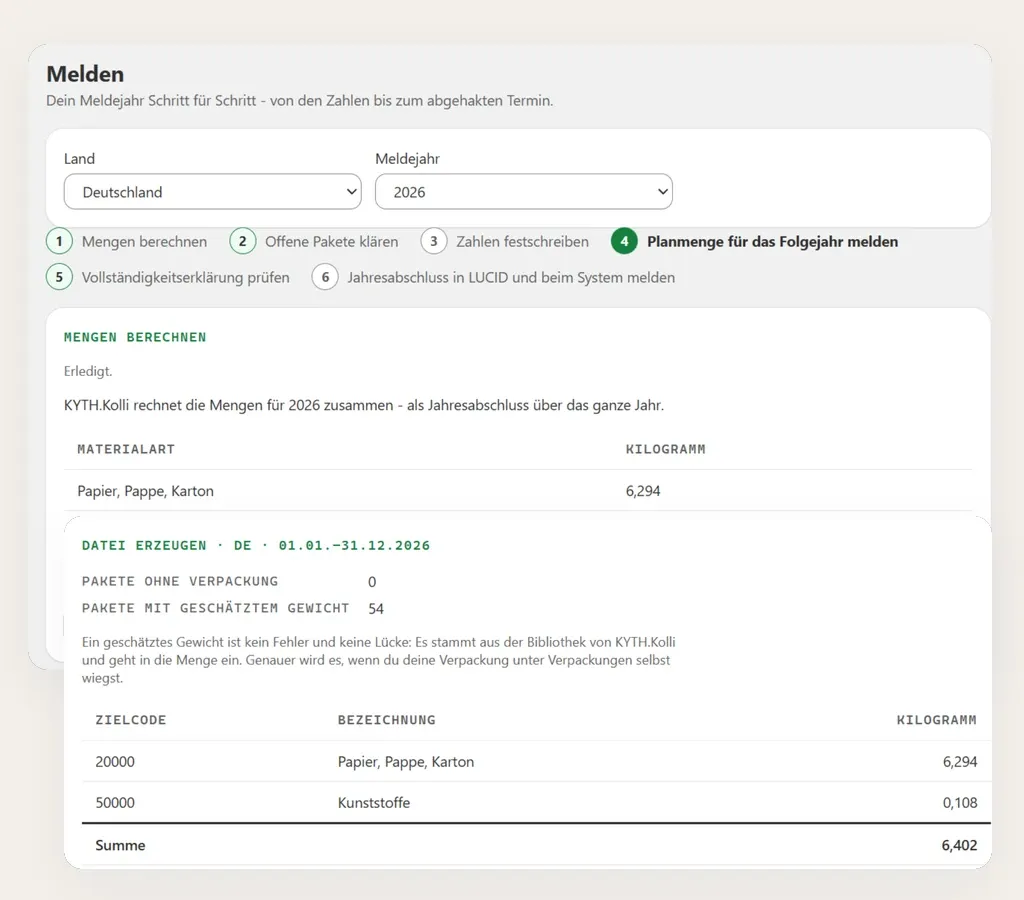
Calculate, check, lock, download the file and tick off the deadline, for Germany and Austria.
Packaging with a weight for each component, plus rules by weight, country or product. The preview shows which parcels a rule matches.
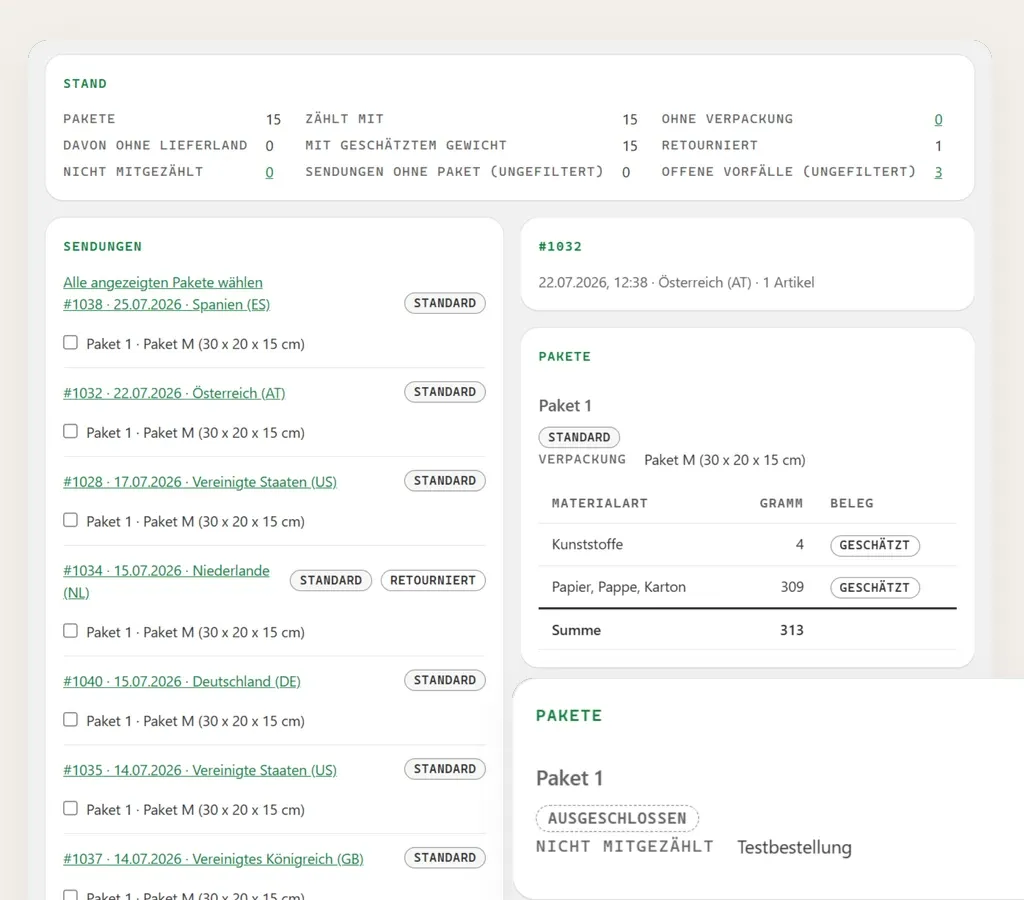
Which packaging, how many grams per material, and why a shipment does not count, for example as a test order.
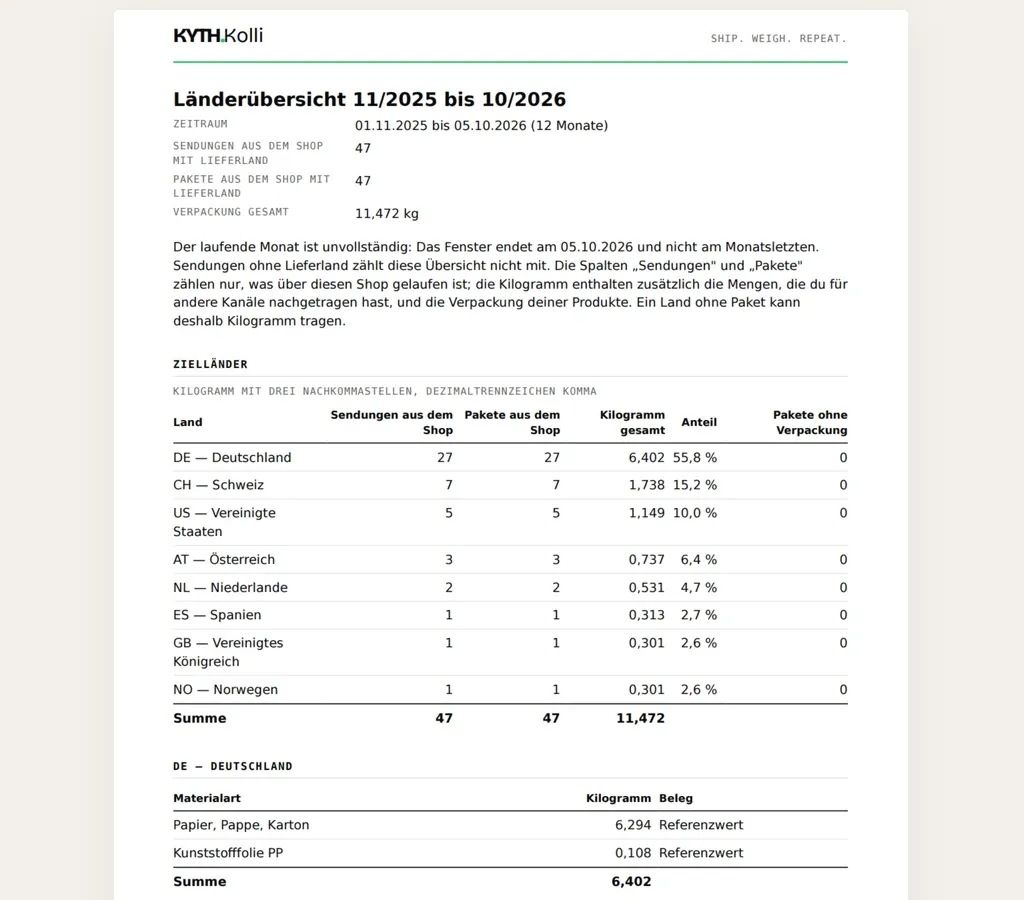
Where you ship how much, with share and materials per country. Plus source, date and the note on the authorised representative under Art. 45 PPWR. On every plan.
The screenshots show KYTH.Kolli with sample data from a development store, not a merchant’s shop. Orders, amounts and destination countries are made up. The costs per country are sample values, not any provider’s prices, and the packaging weights are estimates from the app’s library. The entries under „Laut Quelle“ (according to the source) come from the app’s own research. The app’s interface is German only.
A PDF on every plan, with no parcel limit and no country limit: parcels and kilograms per destination country and material fraction, plus the competent body, threshold, reporting deadline and minimum fee for countries with stored research, each with the date it was retrieved. The kilograms per country and material fraction are on the app’s start page too. That is the basis for your figures; from Starter, „Länder im Vergleich“ (countries compared) sets revenue and estimated costs per country next to it. Before you stop shipping, get the figures.
From Starter: XML for the forecast volume, the year-end volume and amendments, in the structure of the ZSVR guidance “Upload Datenmeldungen im Verpackungsregister LUCID” (version 1.3), with the code set for your reporting year (VerpackG for volumes from 2026, section 68(5) VerpackDG; VerpackDG from reporting year 2027), validated against the schema. You upload it and confirm inside LUCID yourself; the data report is strictly personal, no software takes that off your hands.
Germany only: one row per material type as in LUCID, kilograms to three decimal places with a comma as the decimal separator, in the order of your scheme, which you pick from a list. The same figures as in the LUCID export.
The question “how did you arrive at 612.340 kg of paper/cardboard?” is answered by one document: method, catalogue version with evidence status, allocation rules, an extract of the shipment list with up to 500 rows and a checksum. The document states how many shipments the extract leaves out.
Projected from twelve months for the advance declaration. The deadlines sit in the app’s deadline calendar on every plan for you to tick off, with an email reminder and a monthly report from Starter (via the mail server you set up in the app); the deadlines cover Germany (forecast volume 31 December, declaration of completeness 15 May, year-end volume 1 June) and Austria (annual data to the collection and recovery scheme 15 March). Kolli lists the declaration of completeness as a deadline but does not produce it.
A PPWR table as CSV from Starter and, already on the Free plan, the annual CSV for the home country Germany or Austria. For Austria it is an annual table of volumes per material type from your counted shipments, without added volumes and without product packaging; it does not reproduce the input format of a collection and recovery scheme. You add volumes from marketplaces, in-store sales and B2B by form or CSV. Nothing is locked in until you tick “I have checked the volumes”.
From Starter, with no parcel or country limit. In the app it is called „Länder im Vergleich“: on the start page, each destination country shows parcels and kilograms of packaging next to the net merchandise revenue of your Shopify orders (after discounts and refunds, without shipping and tax, in your shop currency and not converted), plus the estimated costs and their share of revenue. You enter the costs yourself in the administration, as annual fixed costs and a fee per kilogram. For countries with stored research, the minimum fee is shown alongside with its source and date. The period is the last twelve completed months or a completed calendar year, and the table is also available as a CSV. Kolli suggests no fee rates and does not recommend stopping shipments. The decision is yours.
Kolli counts exactly by the piece: how many boxes of which type went to which country. That is a hard number from your shipments. The weight comes from your catalogue, and how good it is depends on you.
You put the packaging on the scales yourself. In the weighing assistant you weigh the same packaging several times, at least three; Kolli gives you the mean and the range, and you adopt the value yourself.
The weight comes from a data sheet or a supplier invoice from your packaging merchant.
An empirical value as a starting point. Kolli marks it visibly as unevidenced: it never disappears quietly into the total.
Kolli rounds nothing up and claims no accuracy your catalogue cannot support.
Packaging volumes need the destination country, not the person. So that is all Kolli stores about your customers:
| Feature | Free US$0 permanently | Starter US$129 per year | Pro US$299 per year |
|---|---|---|---|
| Country overview (PDF), no parcel or country limit | included | included | included |
| Kilograms per country and material fraction | included | included | included |
| Packaging catalogue | included | included | included |
| Product packaging on top of shipping packaging | included | included | included |
| Deadline calendar in the app | included | included | included |
| Parcels per calendar month for files | up to 100 | up to 300 | up to 3,000 |
| Countries for filing files | home country only | home country + 3 in EU/EEA | home country + 10 in EU/EEA |
| Annual CSV (home country Germany or Austria) | included | included | included |
| LUCID XML: forecast volume, year-end volume, amendment | not included | included | included |
| Report for the dual system | not included | included | included |
| Evidence PDF | not included | included | included |
| PPWR table (CSV) | not included | included | included |
| Countries compared: revenue and estimated costs per country | not included | included | included |
| Deadline reminders by email and monthly report (via your own mail server) | not included | included | included |
| Closing package by email after uninstalling (via your own mail server) | included | included | included |
Already using KYTH.Karl? Then at least Starter is included for you, and Karl supplies the packaging actually packed for each shipment.
The parcel limit applies per calendar month, and the busiest month of the period is what counts. It only locks files, never the counting: the annual CSV plus locking in your volumes on Free, and every export file plus locking in your volumes on Starter and Pro. It never locks the country overview, on any plan. Your volumes keep accruing, even if you export nothing for a year.
The country limit applies to the country-specific files and counts per calendar year. On Free you get them for your home country only. Starter covers your home country and up to 3 further delivery countries in the EU and EEA, Pro your home country and up to 10 further ones. Your home country does not count, nor do countries outside the EU and EEA (such as Switzerland, the United Kingdom or the USA); the countries of volumes you add by hand do count. If more delivery countries in the EU and EEA add up in the calendar year than your plan covers besides your home country, the files for all of those delivery countries are withheld, not only for the ones over the limit. The country limit never locks the files for your home country, and on Starter and Pro it never locks those for countries outside the EU and EEA either. The country overview is free on every plan, with no parcel limit and no country limit.
Registering in the LUCID packaging register and reporting to the ZSVR are free of charge. Participation in a dual system is separate, mandatory and chargeable: it depends on material and weight and does not run through us.
Prices in US dollars plus VAT, annual billing in advance only, through your Shopify invoice. Starter and Pro have no trial period; the way in at no cost is the Free plan. Kolli is offered to businesses with a business address in the EU or EEA; the app and the contracts are in German.
This is not small print, it is a product decision. KYTH. is a software company, not a legal or tax advisor, so Kolli gives you figures, sources and dates, and the decision stays with you.
This overview summarises publicly available sources (Regulation (EU) 2025/40; the German VerpackDG, and the VerpackG for volumes from 2026; ZSVR guidance; European Commission proposal COM(2025) 982) and is no substitute for legal or tax advice. The interpretation is currently moving. This page is as of October 2026.
The EU Packaging Regulation (PPWR, Regulation (EU) 2025/40) has applied since 12 August 2026. Its Article 44 provides for registration per member state and an annual volume report by 1 June, including for distance sellers delivering directly to end users in other member states. Kolli gives you the volumes per country and material for that. Kolli does not tell you whether you have to report; that is a question for your advisers.
That depends on your case, and we do not assess it. As a factual summary, as of 3 October 2026: Article 44(2) PPWR provides that producers register in every member state in which they make packaging available for the first time. Member states must set up their registers in the form Article 44 prescribes within 18 months of the entry into force of an implementing act. That act has been published as a draft since 6 August 2026 and has not been adopted, so the deadline does not fall before 2028. Until then the procedures of the individual countries apply: in Germany the Zentrale Stelle Verpackungsregister is the authority responsible for the register under Article 44 and registration takes place in LUCID (section 6(6) VerpackDG), and France has issued an EPR number since 2022. What that means for your shop is a question for a legal or tax adviser.
No. Since 12 August 2026, Article 45(3) PPWR has provided that producers delivering packaged goods directly to end users in another member state (Article 3(1)(15)(c) and (d)) appoint an authorised representative for extended producer responsibility there, even if they are based in the EU themselves. The European Commission has proposed suspending this for EU merchants until 1 January 2035 (COM(2025) 982). As of 3 October 2026 this has not been adopted; the European Parliament plenary reading is provisionally scheduled for 19 October 2026; the Council must then also adopt it. Kolli provides calculations and export files, so it gives you and a representative the figures per country, but does not take on that role. The app says so, with source and date: in the country overview, in the PDF and under “Meldungen” (declarations).
No. Kolli runs on its own with rules and a default packaging. With Karl it gets more precise, because Karl knows which box was actually packed for each shipment.
Continuously from installation. Going back, Kolli reads the current and the previous calendar year when you start the backfill in the app. Kolli shows you the backdating window openly: it never quietly fills in something it has not read.
The report applies per producer across all channels. So you add volumes from marketplaces, in-store sales and B2B by form or CSV; they feed into the same totals.
If you have set up your mail server in the app, you get a closing package by email, on every plan including Free. After that Kolli deletes your shop’s data. Shopify allows 30 days for this.
Filing files for Germany: the annual CSV already on Free, LUCID XML and the dual system report from Starter. Shops based in Austria get the annual CSV as an annual table of volumes per material type, also on Free, from your counted shipments, without added volumes and without product packaging; it does not reproduce the input format of a collection and recovery scheme. Deadlines for Germany and Austria (in the app’s deadline calendar on every plan, email reminders from Starter). The country overview covers every destination country on every plan, and for countries with stored research it adds the competent body, threshold, reporting deadline and minimum fee. For countries other than Germany and Austria Kolli makes no commitment: you get the volumes per country, where stored the research with its retrieval date and, from Starter, the PPWR table, but no file in the format of the national register concerned. Kolli is meant for shops with a business address in the EU or EEA; the app and the contracts are in German.
Kolli can be installed: on the Free plan you see your volumes per country and material type at no cost, for as long as you like, before you book Starter or Pro. The app and the contracts are in German.
View in the Shopify App Store